

This is Part Two of a Three-Part Series: Beef for the Win? And Get Ready Before the FY27 VAPG.
Beef led the national results in the fiscal year 2026 Value-Added Producer Grant round, as I covered in Beef for the Win. USDA announced 194 projects in FY26. Beef producers won 80 of them, 41 percent, and $11.6 million, 44 percent of the dollars. New England’s results look different, and four years of award data show why that is not a problem.
A small region with an outsized share
New England is small farm country. All six states together have 30,717 farms on 3.7 million acres. Oklahoma alone has 70,378 farms on 32.9 million acres. California has 63,134 farms on 24.2 million acres. That puts New England at about 1.6 percent of the nation’s farms and less than half of 1 percent of its farmland. Yet New England won about 6 percent of national VAPG awards in FY23, 4 percent in FY24, 8 percent in FY25, and 4 percent in FY26. Every year, the region won more than its size would predict. New York tells a similar story for three of the four years. It also holds about 1.6 percent of the nation’s farms, and it won between about 4 and 5.5 percent of national awards from FY23 to FY25. FY26 was the exception. New York won three awards, about 1.5 percent of the national total.
What each state won most often
From FY23 to FY26, the raw commodity that won most often in each state was:
Maine: seafood and seaweed, tied with herbal, fiber, and forest products
Vermont: poultry and eggs
Connecticut: dairy
New York: beverages, including juice, wine, and spirits
Massachusetts, New Hampshire, and Rhode Island had no single top product.
The total counts are small over four years. With 40 New England awards, one award can move a product type up or down two places in the ranking.
How VAPG reviewers score an application
VAPG does not score the product type. A dairy project and a seaweed project are judged on the same criteria. Each state’s mix follows what its farms already produce and sell well. Maine’s coastline shows up in oysters, scallops, kelp, and seaweed. New York’s vineyards show up in wine and spirits. These farms had established markets before they applied. Repeat after me: a winning VAPG application, at its most basic, is about the raw commodity you already produce and sell well on your farm. You can apply for a new value-added product or expand an existing one. But you do not need to chase national trends to compete. Our region often bucks them.
To be eligible, you must produce and own more than 50 percent of the raw commodity you are adding value to. A review panel then scores whether the venture is feasible and profitable, whether the team is qualified and experienced, and whether the work plan and budget hold up. If you hate Excel, find someone who loves Excel. Those three sections are worth 70 of the 100 points. The rest come from cash match and priority categories such as beginning and veteran farmers.
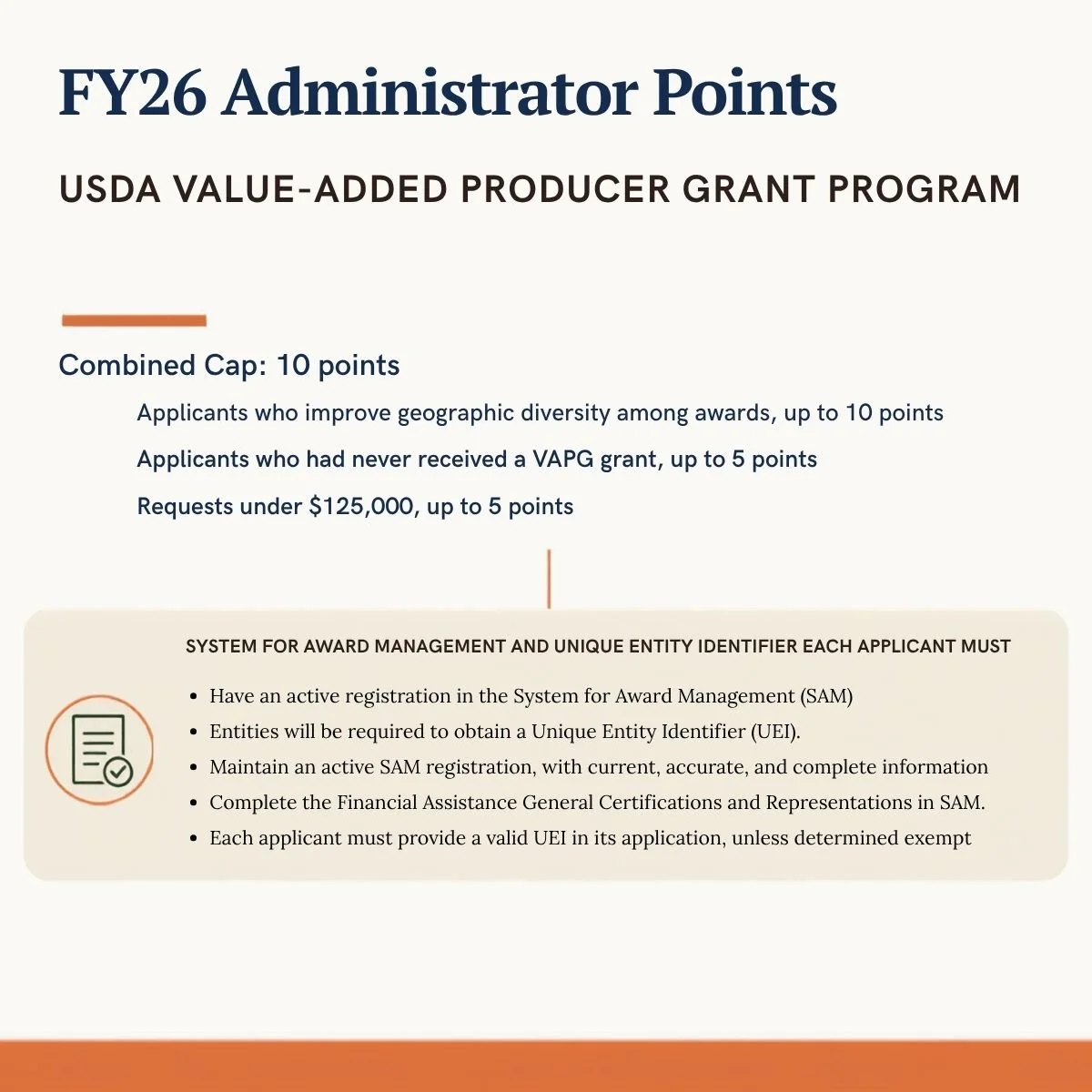
Those categories favor smaller requests, first-time applicants, and places that have not been getting awards. The data does not show which awards received these points, so it cannot prove they made a difference.
What the data does not tell us
Product type is not scored, but some product types win more often than others. The award data shows who won, not who applied, and it does not show how any project scored.Looking ahead to FY27, here’s the catch
Nothing in the FY26 notice favored any product. If a new priority appears, it will most likely show up in the Administrator points, which are added after the review panel scores each application.
But who sets those priorities has also changed. On August 7, 2025, President Trump signed Executive Order 14332, Improving Oversight of Federal Grantmaking. It requires each federal agency to designate a senior appointee to approve funding notices and review discretionary awards for consistency with agency priorities and the national interest. The order defines a senior appointee as an individual appointed by the President, a non-career member of the Senior Executive Service, or a top-grade Schedule C political appointee. It also states that peer review recommendations, from the people who read and score your applications, are advisory. When the FY27 notice is out, the Administrator points section is the first place to look for policy changes.
Looking to learn more about the Value-Added Producer Grant? Book a no-pressure 30-minute call with me.
Sources